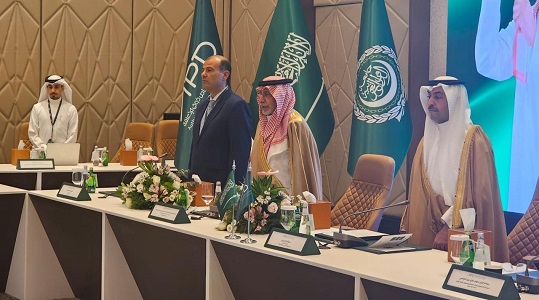
The Secretary-General of the Union of Arab Chambers, Dr. Khaled Hanafy, revealed during his speech at the opening of the “High-Level Conference on Accessible Tourism for Persons with Disabilities,” held in Riyadh, the capital of the Kingdom of Saudi Arabia, from November 12 to 13, 2025, organized by the League of Arab States and the Authority for the Care of Persons with Disabilities in the Kingdom of Saudi Arabia. The event was attended by His Highness Prince Faisal bin Farhan Al Saud, President of the Arab Council for Accessible Tourism, Dr. Hisham Al-Heidari, CEO of the Authority for the Care of Persons with Disabilities in the Kingdom, as well as official and ministerial delegations, and a distinguished group of businessmen and investors from 16 Arab countries. Dr. Hanafy stated that estimates by the World Health Organization indicate that around 1.3 billion people worldwide live with disabilities—approximately 16 percent of the global population—and this segment represents a promising market for travel and tourism.
Dr. Hanafy expressed his appreciation to the Authority for the Care of Persons with Disabilities in the Kingdom of Saudi Arabia, represented by its CEO Dr. Hisham Al-Heidari, and to the League of Arab States, represented by His Excellency Minister Plenipotentiary Dr. Tarek Al-Nabulsi, who has exerted—and continues to exert—great efforts to organize and ensure the success of this pioneering event that embodies an advanced Arab human and economic vision. He considered that “accessible tourism represents a significant economic opportunity for destinations that have prepared for it. However, challenges and obstacles remain, as a large percentage of people with disabilities still face difficulties while traveling—96 percent of travelers with disabilities experience problems in tourist accommodations, and 79 percent face difficulties in transportation.”
He pointed out that “making tourism accessible for all is a commitment to human dignity and, at the same time, an economic investment that benefits society as a whole. From this standpoint, we in the Union of Arab Chambers highly value the pioneering efforts led by the Kingdom of Saudi Arabia in assessing tourism infrastructure and services and in developing legislation and technical standards to make them more accessible and inclusive for persons with disabilities. We also see in this experience a model to be followed at the Arab regional level, as it carries an integrated human and economic message affirming that true development can only be achieved through the participation of everyone—without discrimination or exclusion.”
The Secretary-General, Dr. Khaled Hanafy, called for “adopting a roadmap for action based on improving infrastructure and services, developing the skills of tourism sector workers, creating specialized tourism products and services, establishing partnerships among the public and private sectors and civil society, as well as monitoring performance and measuring impact.”
In his speech during the fifth session titled “Toward an Arab Strategy for Accessible Tourism,” Dr. Hanafy stated that “accessible tourism is not only a human right but also a developmental and economic opportunity that can create added value and sustainability in our Arab economies.”
The Secretary-General outlined the strategic vision proposed by the Union of Arab Chambers, which can be adopted by Arab countries in cooperation with the private sector, chambers of commerce, specialized councils, and international organizations. The proposed pillars include “the need to establish a unified Arab legislative and regulatory framework through the proposal of an ‘Arab Guide for Tourism Accessibility,’ and to encourage countries to update their building regulations, tourism licensing systems, and hotel standards to mandate that a certain percentage of rooms and facilities be prepared to accommodate people with disabilities. It is also important to promote investment and partnership between the public and private sectors by offering incentives such as tax exemptions, reduced licensing fees, and credit guarantees for those applying accessibility standards.”
He continued: “Employees in hotels, airports, and tourist sites should be trained to understand the needs of visitors with disabilities. Awareness campaigns under the slogan ‘Tourism for All’ should also be launched, targeting investors, decision-makers, and the private sector, to highlight the economic and social benefits.”
Dr. Hanafy emphasized the importance of digitizing services and the experience of accessible tourism by developing Arab applications and platforms that provide accurate information about ‘facilities equipped for tourists with disabilities’ (hotels, restaurants, attractions, and transportation). He also proposed the use of augmented reality or virtual reality technology to offer ‘virtual tours’ of accessible facilities, increasing trust and speeding up decision-making for visitors.
He concluded by saying that “building an Arab strategy for accessible tourism is an investment in people before being an investment in infrastructure. It is a necessary step toward a more inclusive, equitable, and sustainable Arab economy. Through joint work between the public and private sectors, chambers of commerce, and relevant organizations, Arab countries can position themselves among the world’s leading destinations that ensure no one is left outside the tourism circle.”
Source (Union of Arab Chambers)
